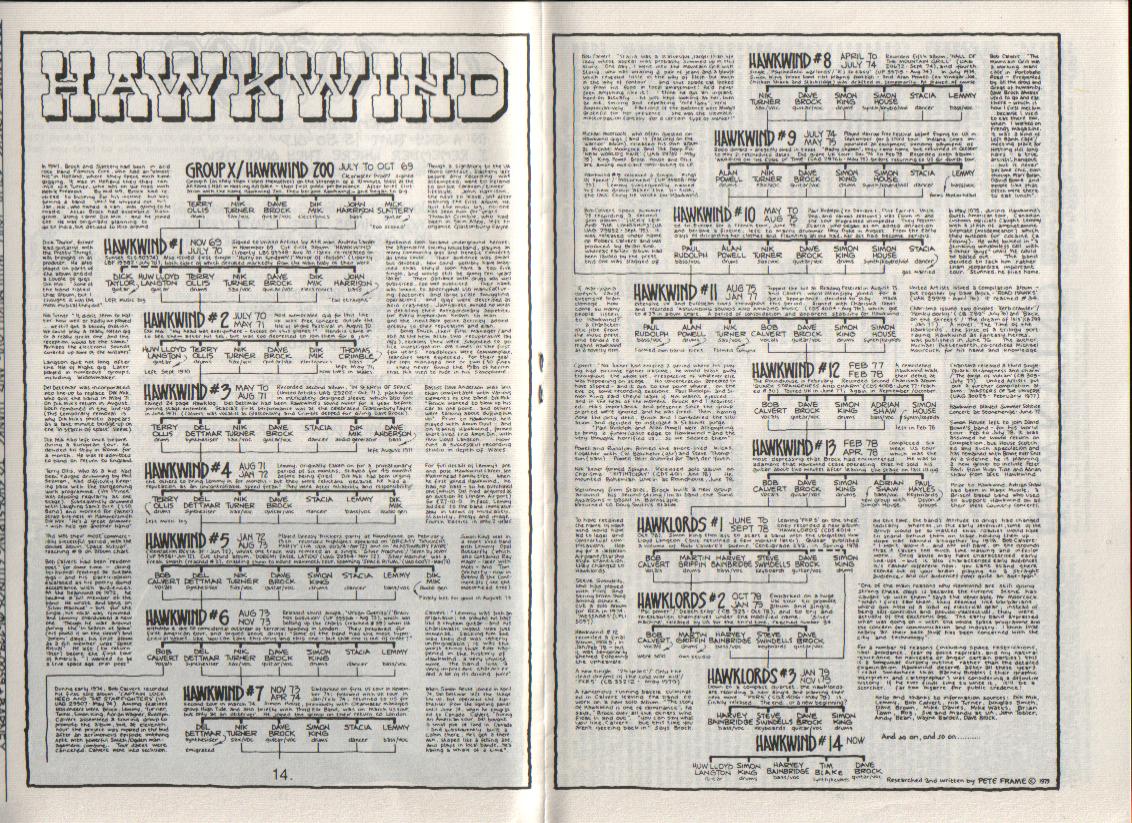
Back at my folks’ house a few weeks ago, my Dad gave me a box: inside were various bits of paper, notes, magazines, fanzines, and concert programmes from the late seventies: the last kibble left behind when I left home.
Among the gems (more later) was this Zigzag. Founded by Pete Frame in 1969, this well-respected British Rock Journal had, by 1978, come thoroughly under the Punk Spell, thanks to new editor Kris Needs.
The layout is a curious hybrid: text is mostly properly typset (which in those pre-DTP days meant professional) but the subject matter and the then-current DIY aesthetic meant that layouts also included felt-tip scribbly headlines, rules and page numbers, giving a more fanzine-ish feel.
Like everybody else, I know in my heart-of-hearts that the music being made when I was in my teens is the absolute, ultimate, best ever. So if you’re in your mid forties like me, you’re sure to enjoy these articles on The Raincoats, Suicide, John Otway, Steel Pulse and The Human League. Even the piece on cover stars The Rich Kids is an interesting bit of “Slik-Pistols-Vox-Visage-Pistols-again” history. And there’s a column by the great John Walters to boot.
But the best piece has to be the interview with my then-favourite band, The Rezillos, by Cramps LegionnaireLindsay Hutton. Here’s the Rezillos piece (click for bigger, readable pages):
While searching for recordings of R. Crumb’s Sweet Shellac radio show (from BBC Radio 3, a few years ago), I came across this little gem of English double entendre thirties jazz. If you’re fortunate enough to have a copy of my Love at First Sound mix CD, you’ll have heard Crumb’s Cheap Suit Serenaders perform a loving remake of this sweet record, complete with cod-English accents.
The double entendre smut is laid on trowel thick: worthy of the great Mrs. Slocombe herself, in fact.
Of course you can find whatever you want on the ole international packet switching network, if you’re smart or dogged enough (or both), and I tracked down Sweet Shellac on eyecandyman's interesting blog of old-time music and Honk Honk exploitation movies. He’s even got video of R. Crumb and his fellow old-time music enthusiast Robert Armstrong listening to this very record.
We start with a track from Lee Scratch Perry's great Battle of Armagideon (Millionaire Liquidator) from 1986. A cassette tape of this album was always by my kitchen machine back then, and "Show Me That River" always seemed to come on when I was doing the washing up. It always seemed appropriate, with it's "Wash all my troubles away" line. But like a lot of Lee lyrics, it was just slightly crazy:
Show My that river,
Take me Icarus,
And wash all my troubles away.
Like that lucky old sun,
I've nothing to do,
But rolling in heaven all day.
Sounds to me like Perry's magpie, gadfly, creative mind has morphed "across" into "Icarus" here, under the influence of the sun mentioned in the next bit.
Then I found this Prince Buster Tutti Frutti LP in the 50p bin at my local second hand record shop; and the song "Wash Wash" seemed familiar.
Show My that river,
Take me across,
And wash all my troubles away...
Aha! "Across" here! Of course the music industry in general, and the Jamaican music industry in particular, have never been that fastidious about nicking bits of songs from each other. And before you Prince Buster fans out there start looking down on the Scratch fans, wait: Mr Bustamente nicked it himself.
That Lucky Old Sun was a big hit for Frankie Laine in 1949. It was written by Beasley Smith and Haven Gillespie, and was covered many times, by the likes of Vaughn Monroe, Ol' Frankie, Jerry Lee Lewis and Ray Charles.
Here's Louis Armstrong's version.
This version, with its sacred, gospelly overtones, is clearly implying that the river being shown is the Jordan, and the point where the troubles are washed away is death. Or maybe the Styx, I suppose, but nobody ever got washed in the Styx, unless they got thrown overboard by the ferryman, maybe.
I must have heard this song on the Radio in the early seventies, when I still had that child’s thirsty cultural-vacuum-cleaner brain: and for years later the chorus would leap back into my mind at odd moments, though I couldn’t remember the title or artist. Before I’d even heard of double tracking (recording a lead vocal twice to beef up a weak performance) I would think of it as that “hurts-so-good” sound. Until I eventually found it by accident on one of those cheapo reggae compilation LPs, in the eighties. And the reason it had stuck became clear: it was a Lee “Scratch” Perry production.
But then I found out that it was actually a Millie Jackson song. Of course I should have known: Millie is, after all, the queen of the I-Love-You-You-Bastard genre. Here she is singing it on Soul Train, in 1973 at a guess:
The best known story about the Mighty Terror is probably too good to be true: how, when he arrived in from Trinidad in London in 1953, he asked the taxi driver to take him to the home of Lord Kitchener. The terror was obviously (to us) referring to the Great Calypsonian, but the confused taxi driver at first thought he was referring to the long-dead British Imperialist War Hero. Hilarious consequences ensued. Right.
Anyway, for us bleeding-heart liberal middle class muddle-headed do-gooder pinko types, the only time we can tolerate Sexism or Affection for the Police Force is when it comes out of the mouth of an Ethnic Minority Person. Here's The Terror fondly dreaming of being arrested by a nice “blondie one”.
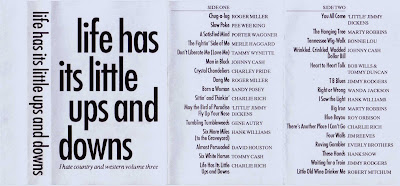
Here’s one of my early nineties Country & Western mix tapes. Since the source is a cassette tape recording of mostly vinyl (and some cassette), the sound quality is hardly pristine, with both vinyl pop & crackle and tape hiss. I decided not to even try to filter any of this out, partly through laziness, partly for anyone nostalgic for the pre-digital experience. Any high-fidelity seekers after perfection among you will have to look elsewhere.
Life Has Its Little Ups and Downs
I hate Country & Western Volume 3
Side One
Chug-a-lug — Roger Miller
Slow Pole — Pee Wee King
A Satisfied Mind — Porter Wagoner
The Fightin’ Side of Me — Merle Haggard
Don’t Liberate Me (Love Me) — Tammy Wynette
Man in Black — Johnny Cash
Crystal Chandeliers — Charley Pride
Dang me — Roger Miller
Born A Woman — Sandy Posey
Sittin’ and Thinkin’ — Charlie Rich
May the Bird of Paradise Fly Up Your Nose — ‘Little’ Jimmy Dickens
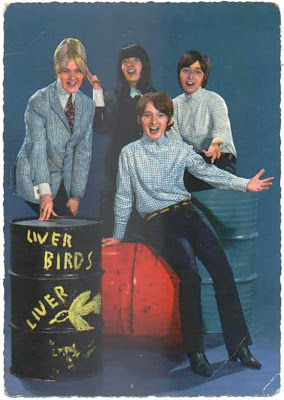
No, No, No! Nothing to do with Nerys Hughes, Mollie Sugden, or Lucian’s rabbits. I’m talking about a sixties all-girl beat combo who, like Carla Lane, took the name from the statues on the top of the Liver Building.
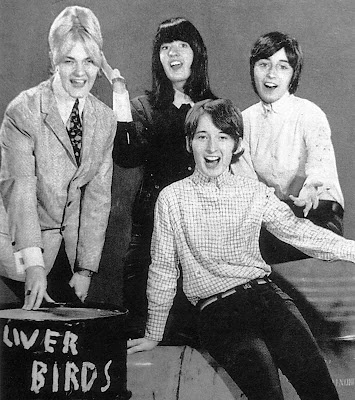
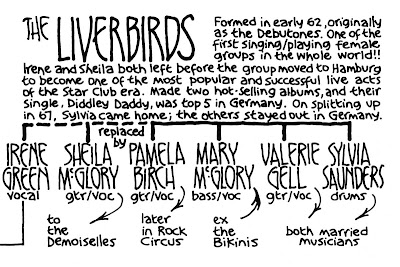
Pete Frame’s intricately hand-lettered flow-diagram histories of rock bands and their members are at once an elegantly simple way of communicating complicated information, and beautiful examples of handmade graphic art. I savoured them wherever I found them (his own Zigzag magazine, for instance, and Sounds), and bought and devoured the book collections. They were so good, it was even a pleasure to read about bands i didn’t care much about, or even actively disliked (Journey, Asia, The Eagles). When his third collection The Beatles and Some Other Guys: Rock Family Trees of the Early Sixties came out, I was a little apprehensive to discover that it contained photographs: “Surely a dilution of the purity of his art?” screamed the Raging Aesthetic Puritan within me. But upon flicking through the book, those doubts vanished when I found this picture:
(Click on any picture for a bigger version)
“Wow! An all-girl mersybeat group! Cool!” I thought. Then I found the entry on them in the previous page’s tree:
This looks pomising: although I’d never heard of them before, they had been big enough in Germany to make two albums. And the one recording mentioned by name was a Bo Diddley song: excellent taste in covers, then. I was hooked: I had to hear them. But how?
I asked all my knowledgeable muso mates: they all said “What? the TV series?” Eventually Davie said I should try George. Of course! I should have thought of George earlier. We even worked in the same building at the time. So the next time I spotted him, in the Smoking Room (yes, this is so long ago that not only were there smoking rooms, but I was in them, smoking), I asked. He frowned, and thought for a moment, and said “Yes, I know who you mean. Might have a track or two, on a compilation, somewhere. Not very good, as I remember.”
Well that was hardly encouraging. I basically stopped looking, after that. But then the internet happened, and I found a few MP3s on the sainted audiogalaxy. And George was right. Not unpleasant, adequately performed, typical mid-sixties British lead-&-chorus-vocal/lead/rhythm/bass/drums beat music.
But still, I had the photograph. Do I have to explain what’s so good about it? Maybe the fact that they all look so individual: that even although they’re doing fake goofy pop group gestures for the camera, their smiles seem fairly genuine.Or the badly hand-painted “LIVER BIRDS” on the oil drum. Oh, go on then, I have to admit it to myself: it’s Sylvia Saunders' definitely dykey “pseudo-sideburn” locks of hair in front of her ears. Frankly, they make her look like me when I was fifteen.
Preparing for this post, I thought I’d have another trawl of the internet, in case there was some lost gem of a good record out there. I did find a few more, but more importantly, I found (drum roll…) A colour version of the photograph!
Woohoo! Their’s even a rubbish painting of a bird on the oil drum!
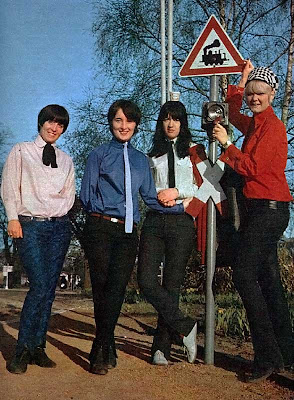
But wait! I found another photograph:
Check out that cup on Val Gell’s head!
Make your own mind up: here’s their top 5 hit in Germany:
Nobody could possibly be a bigger Margaret Rutherford fan than me: she's my magic third granny. So when got the chance to watch all of the old Miss Marple movies recently, thanks to my postal DVD rental service, I was surprised by how, well, boring they were. Pedestrian pacing, ludicrous plots, four-square, dull cinematography and editing. I could hardly believe these were the same films that had kept me glued to the telly as a child. No criticism of Rutherford herself, mind: immune to bad scripts and bad direction, she is never anything but delightful to watch.
And the other factor that has not lost any of its sparkle is, of course, Ron Goodwin's fabulous theme tune.
Here it is: go, on stick it on your iPod and walk down the street in shuffle mode: when it comes on, you'll find the gritty urban desolation around you (I'm absolutely convinced that EVERYONE who reads this blog lives in a sprawling, dangerous, crime-ridden ghetto) will suddenly become a grainy black and white home counties village in 1964: particularly when the harpischord bit comes in. Try it.
Back in the late seventies, “Fleetwood Mac” was a dirty word (dirty phrase?), at least it was if you were a punk/new-wave/power-pop person like what I was. Alongside Journey, Kansas and Foreigner, they represented all that we hated about smug, comfortable American FM-radio stadium rawk. So how did a groovy plastic (in a good way) punky pop group like the Rezillos get away with doing a Fleetwood Mac cover? After all, they did choose to stop playing the blessed Joe Meek’s Have I The Right when manufactured boy band The Dead End Kids had a minor hit with it.
Well, to begin with, it’s not technically a Fleetwood Mac song . Back in their UK-based, blues-band-fulla-guitarists period in the late sixties, they would goof off by playing pastiches of old rock’n’roll numbers, and calling themselves “Earl Vince and the Valiants”. And one song, this one, managed to get on the B-side of a proper Fleetwood Mac single (Man of the World). The song was also easily the “punkyest” in the Rezillos’ repertoire: with all there other stuff being about science fiction and sculptures and luv, this one was their only song dealing with violence. And it was fast too, at least the way the Rezillos performed it.
So I guess Eugene, Faye and the boys just hoped nobody in the audience had that old Fleetwood Mac single. Or indeed Blues Leftovers, the cheapo Immediate Records compilation where I found it.
So here it is, with Jeremy Spencer’s brooding Elvisish (Elvine? Elvistic?) vocal.
Way back in the nineties, my home-made I Hate Country & Western cassettes were to be found in the tottering piles next to cassette machines around Glasgow. Followed by Hey, I'm not fussy... I hate everything, then moving to CD with I Hate Mento, Love at First Sound, Jiggery Pokery and Black Salad. Now it's time to bring my shitey old music discoveries into the twenty-first century.




 .